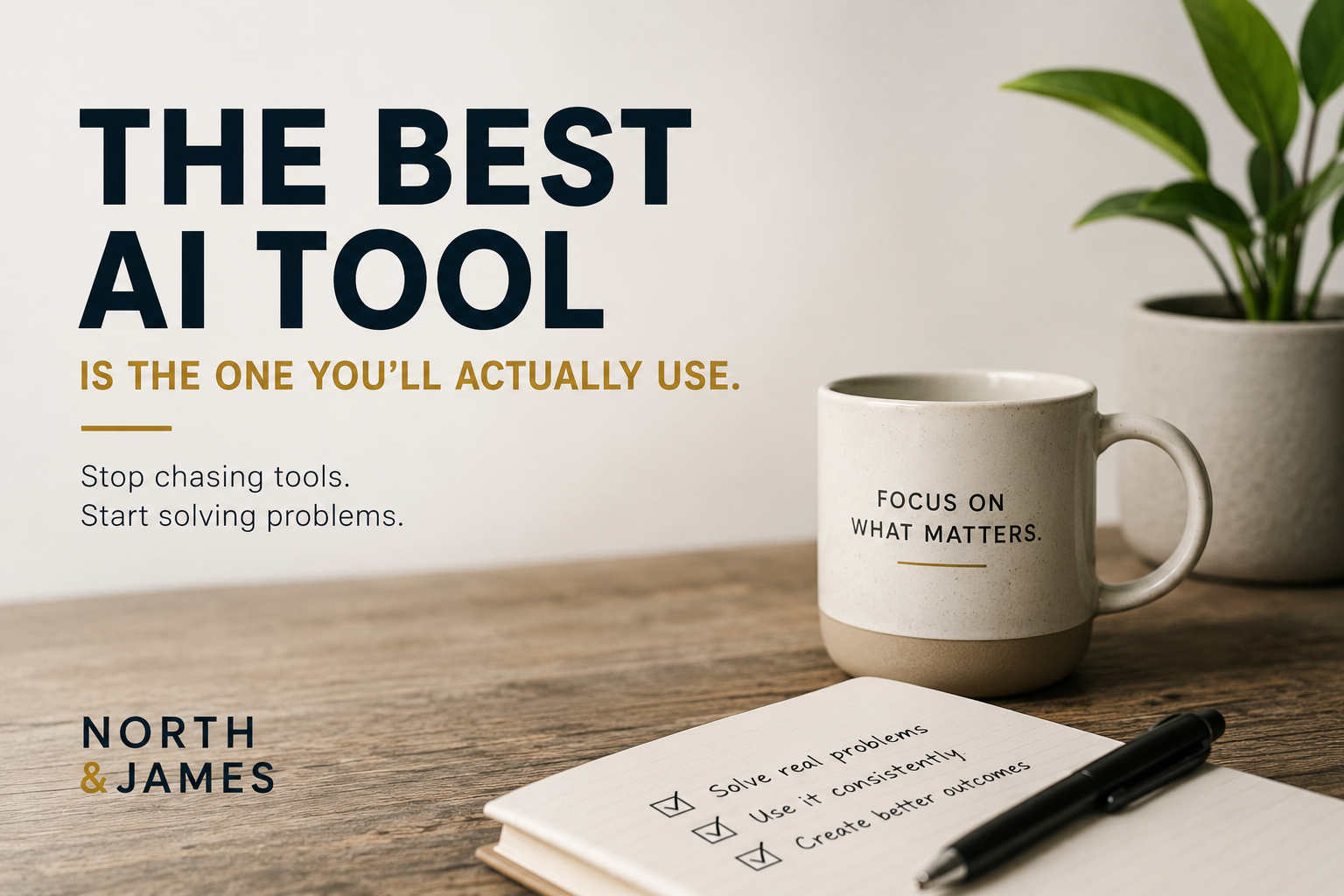
The value of AI isn't found in having the most tools. It's found in consistently using the right tool to solve real business problems.
Spend a few minutes reading about artificial intelligence online and you'll quickly come away with the impression that you're already behind.
Every week there's a new tool. A new feature. A new platform promising to revolutionize the way you work.
One article says you need ChatGPT. Another says Claude is better. Someone else insists that Copilot is the future. Then a software company you've never heard of appears with a product that claims to replace all of them.
For a small business owner, it can start to feel overwhelming.
The problem is that most of the conversation is focused on tools instead of outcomes.
The average business owner doesn't wake up wondering which AI platform to use. They wake up wondering how to respond to customers faster, finish proposals more efficiently, keep projects organized, and find a few extra hours in the week.
Those are the problems worth solving.
In our experience, the businesses getting the most value from AI are rarely the ones using the most tools. They're usually the ones using one or two tools consistently and intentionally.
A company that uses ChatGPT every day to draft customer communications, summarize meeting notes, create first drafts of proposals, and organize internal documentation will often see more value than a company experimenting with ten different platforms once a month.
The reason is simple. Habits create results. Collections of software do not.
This isn't a new lesson. Most businesses have experienced it before.
A company can buy the most sophisticated project management platform available and still miss deadlines if nobody uses it. A customer relationship management system is only valuable if information is consistently entered and maintained. The same principle applies to AI.
The best tool is not necessarily the most advanced. It's the one that fits naturally into the way your team already works.
For some organizations, that might be ChatGPT. For others, it could be Copilot because it lives inside the Microsoft tools they use every day. The specific platform matters far less than the consistency of adoption.
Before evaluating another AI tool, it's worth asking a different question.
What problem are we actually trying to solve?
If the answer is reducing time spent on administrative work, improving follow-up, organizing information, or creating better first drafts, there's a good chance the tools you already have can help.
Most businesses don't have a technology shortage. They have an implementation shortage.
The companies seeing meaningful results from AI are not chasing every new release. They're identifying a handful of repetitive tasks, building simple workflows around them, and improving those workflows over time.
It's not particularly exciting.
It's also where most of the value lives.
Artificial intelligence will continue to evolve. New tools will appear. Existing tools will improve. The headlines will continue to tell you that the next platform changes everything.
Maybe it will.
But for most small businesses, the better approach is usually much simpler.
Pick a tool.
Learn it well.
Use it consistently.
Then spend your energy solving business problems instead of shopping for software.
30 minutes. No pressure. Just an honest conversation about where AI can help your business.